
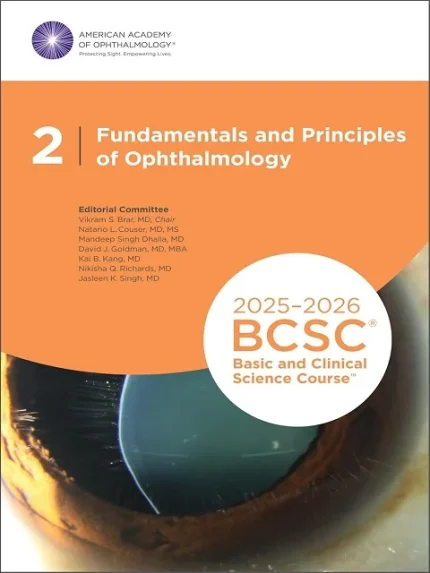
2025-2026 Basic and Clinical Science Course, Section 02: Fundamentals and Principles of Ophthalmology
Black & White Print Color Matt Paper Print |
2025-2026 Basic and Clinical Science Course, Section 02: Fundamentals and Principles of Ophthalmology
2025–2026 Basic and Clinical Science Course (BCSC), Section 2: Fundamentals and Principles of Ophthalmology is the definitive guide to the core principles of eye care and ophthalmic practice, published by the American Academy of Ophthalmology. This section provides a solid foundation for ophthalmology residents, medical students, optometrists, and eye care professionals who are beginning their journey in the field of ophthalmology.
This edition covers essential topics such as ocular anatomy, physiology, optics, visual pathways, ocular pharmacology, and the principles of ophthalmic examination. It introduces readers to clinical reasoning, patient evaluation, and diagnostic techniques, preparing them to understand more advanced sections of the BCSC series.
Key Features
Covers core principles of ophthalmology, including anatomy, physiology, optics, and visual pathways
Introduces clinical reasoning, patient evaluation, and diagnostic techniques
Integrates foundational science with practical clinical application
High-quality illustrations, diagrams, and clinical photographs
Updated 2025–2026 evidence-based guidelines and best practices
Emphasizes patient-centered care, examination skills, and decision-making
Provides a strong foundation for advanced ophthalmic subspecialties
Ideal for ophthalmology residents, medical students, optometrists, and trainees
Essential for board review, clinical reference, and CME
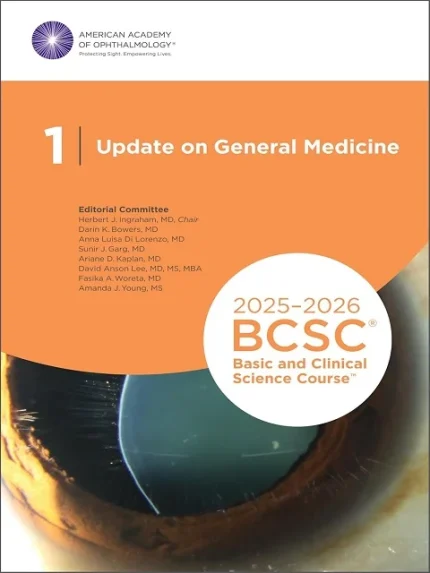
2025-2026 Basic and Clinical Science Course, Section 1: Update on General Medicine
Black & White Print Color Matt Paper Print |
2025-2026 Basic and Clinical Science Course, Section 1: Update on General Medicine
2025–2026 Basic and Clinical Science Course (BCSC), Section 1: Update on General Medicine is the authoritative reference for general medical principles relevant to ophthalmology, published by the American Academy of Ophthalmology. This section serves as a vital foundation for ophthalmology residents, fellows, and practicing eye care professionals, ensuring they understand the systemic conditions that impact ocular health.
This edition provides comprehensive updates on cardiovascular, endocrine, neurological, infectious, and autoimmune diseases, emphasizing their relevance to eye care. It covers pathophysiology, clinical manifestations, diagnostic approaches, and management strategies, helping ophthalmologists recognize systemic conditions that can influence ocular disease and patient outcomes.
Key Features
Comprehensive coverage of general medical conditions relevant to ophthalmology
Integrates pathophysiology, diagnosis, and management with ocular correlations
High-quality tables, diagrams, and clinical illustrations
Focus on clinical reasoning, patient evaluation, and interprofessional care
Updated 2025–2026 evidence-based guidelines and emerging therapies
Covers cardiovascular, endocrine, neurological, infectious, and autoimmune disorders
Emphasis on conditions that impact eye health and patient outcomes
Ideal for ophthalmology residents, fellows, and practicing clinicians
Essential for board review, clinical reference, and CME

2025-2026 Basic and Clinical Science Course, Section 10: Glaucoma
Black & White Print Color Matt Paper Print |
2025-2026 Basic and Clinical Science Course, Section 10: Glaucoma
2025–2026 Basic and Clinical Science Course (BCSC), Section 10: Glaucoma is the authoritative reference on glaucoma diagnosis, pathophysiology, and management, published by the American Academy of Ophthalmology. This section is an indispensable resource for ophthalmology residents, fellows, practicing ophthalmologists, and eye care specialists seeking comprehensive, evidence-based guidance on the evaluation and treatment of glaucoma and related optic neuropathies.
This edition provides in-depth coverage of glaucoma epidemiology, risk factors, molecular and cellular mechanisms, and optic nerve pathophysiology. It details diagnostic strategies, including tonometry, visual field testing, optic nerve imaging, and gonioscopy, and integrates modern therapeutic approaches, encompassing medical therapy, laser interventions, and surgical options such as trabeculectomy, minimally invasive glaucoma surgery (MIGS), and tube shunts.
Key Features
Comprehensive coverage of glaucoma pathophysiology, diagnosis, and management
Integrates basic science with clinical application
Detailed discussion of diagnostic tools: tonometry, visual fields, imaging, gonioscopy
Covers medical, laser, and surgical treatment modalities
High-quality clinical images, illustrations, and procedural diagrams
Updated 2025–2026 evidence-based guidelines and research findings
Focus on patient monitoring, outcomes, and complication management
Includes special populations and advanced glaucoma therapies
Ideal for residents, fellows, practicing ophthalmologists, and eye care specialists
2025-2026 Basic and Clinical Science Course, Section 11: Lens and Cataract
Black & White Print Color Matt Paper Print |
2025-2026 Basic and Clinical Science Course, Section 11: Lens and Cataract
2025–2026 Basic and Clinical Science Course (BCSC), Section 11: Lens and Cataract is the definitive resource for understanding lens anatomy, physiology, and cataract management, published by the American Academy of Ophthalmology. This section is an essential reference for ophthalmology residents, fellows, practicing ophthalmologists, and eye surgeons seeking comprehensive, evidence-based guidance on cataract diagnosis, surgical intervention, and lens-related disorders.
This edition provides in-depth coverage of cataract epidemiology, pathophysiology, clinical evaluation, and surgical management. Readers gain expertise in modern surgical techniques, including phacoemulsification, femtosecond laser-assisted cataract surgery, intraocular lens (IOL) implantation, and advanced refractive lens procedures. The text also addresses complications, postoperative care, and outcomes assessment, ensuring a complete understanding of cataract surgery from preoperative planning to long-term follow-up.
Key Features
Comprehensive coverage of lens anatomy, physiology, and cataract management
Integrates foundational science with clinical practice
Detailed discussion of surgical techniques: phacoemulsification, femtosecond laser, IOL implantation
High-quality illustrations, clinical photos, and procedural diagrams
Updated 2025–2026 evidence-based guidelines
Includes complications management, outcomes assessment, and postoperative care
Focus on patient safety and surgical decision-making
Ideal for ophthalmology residents, fellows, and practicing surgeons
Essential for board review, clinical reference, and CME

2025-2026 Basic and Clinical Science Course, Section 12: Retina and Vitreous
Black & White Print Color Matt Paper Print |
2025-2026 Basic and Clinical Science Course, Section 12: Retina and Vitreous
2025–2026 Basic and Clinical Science Course (BCSC), Section 12: Retina and Vitreous is the definitive resource for understanding retinal and vitreous disorders, published by the American Academy of Ophthalmology. This section is designed for ophthalmology residents, fellows, practicing ophthalmologists, and retina specialists seeking a comprehensive, evidence-based guide to diagnosis, treatment, and management of retinal diseases.
This edition provides in-depth coverage of retinal anatomy, physiology, and pathophysiology, along with clinical guidance on common and complex retinal conditions such as diabetic retinopathy, retinal vein and artery occlusions, macular degeneration, retinal detachments, inherited retinal disorders, and vitreoretinal interface diseases. Both medical and surgical management strategies are discussed, giving readers a complete understanding of contemporary retinal care.
Key Features
Comprehensive coverage of retinal and vitreous disorders
Integrates basic science with clinical practice
Detailed discussions of medical and surgical management
High-quality clinical images, illustrations, and procedural diagrams
Updated 2025–2026 evidence-based guidelines
Covers anti-VEGF therapy, retinal imaging, and emerging therapies
Emphasis on diagnosis, outcomes, and complication management
Ideal for ophthalmology residents, fellows, and retina specialists
Essential for board review, clinical reference, and CME
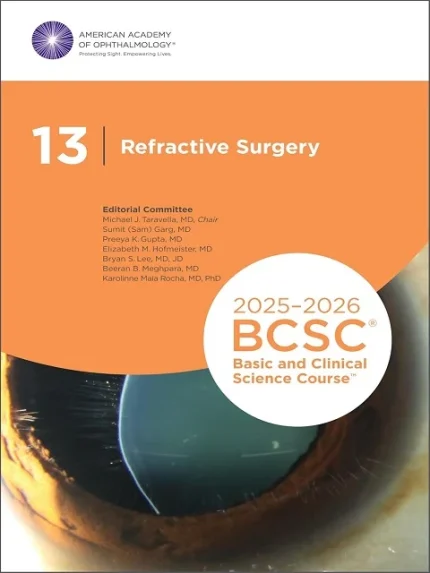
2025-2026 Basic and Clinical Science Course, Section 13: Refractive Surgery
Black & White Print Color Matt Paper Print |
2025-2026 Basic and Clinical Science Course, Section 13: Refractive Surgery
2025–2026 Basic and Clinical Science Course (BCSC), Section 13: Refractive Surgery is the authoritative guide to refractive surgery and vision correction procedures, published by the American Academy of Ophthalmology. This section is an essential resource for ophthalmology residents, practicing ophthalmologists, refractive surgeons, and eye care professionals seeking comprehensive, evidence-based knowledge on surgical correction of refractive errors.
This edition provides detailed coverage of all aspects of refractive surgery, including laser procedures (LASIK, PRK, SMILE), corneal refractive techniques, lens-based surgeries, and emerging technologies. It integrates the latest research, surgical innovations, and clinical best practices to guide both surgical planning and patient care. Key topics include preoperative assessment, patient selection, outcomes evaluation, management of complications, and long-term follow-up.
Key Features
Comprehensive coverage of refractive surgery techniques: LASIK, PRK, SMILE, and lens-based procedures
Integrates foundational science with clinical application
Includes preoperative evaluation, patient selection, outcomes, and complication management
High-quality illustrations, clinical images, and procedural diagrams
Reflects 2025–2026 updated guidelines and evidence-based practices
Addresses emerging technologies and trends in vision correction
Ideal for ophthalmology residents, surgeons, and eye care professionals
Essential for board preparation, clinical reference, and continuing education
2025-2026 Basic and Clinical Science Course, Section 3: Clinical Optics and Vision Rehabilitation
Black & White Print Color Matt Paper Print |
2025-2026 Basic and Clinical Science Course, Section 3: Clinical Optics and Vision Rehabilitation
2025–2026 Basic and Clinical Science Course (BCSC), Section 3: Clinical Optics and Vision Rehabilitation is the authoritative guide to optical principles, visual function, and vision rehabilitation, published by the American Academy of Ophthalmology. This section is essential for ophthalmology residents, optometrists, vision scientists, and eye care professionals seeking comprehensive, evidence-based guidance on clinical optics, refractive correction, and rehabilitation strategies for patients with visual impairment.
This edition provides in-depth coverage of refractive errors, lenses, prisms, optical devices, and low vision aids, as well as advanced topics in visual perception, binocular vision, and adaptive technologies. It emphasizes both diagnostic and therapeutic applications, enabling clinicians to optimize visual outcomes for patients with a wide range of ocular conditions. Key topics include refraction, contact lens fitting, spectacle design, and strategies for patients with low vision or visual field deficits.
Key Features
Comprehensive coverage of clinical optics, refractive correction, and vision rehabilitation
Integrates foundational optical science with practical clinical application
Detailed guidance on refraction, lenses, prisms, contact lenses, and low vision aids
Covers visual perception, binocular vision, and adaptive technologies
High-quality diagrams, clinical photographs, and illustrations
Updated 2025–2026 evidence-based guidelines and innovations
Emphasis on patient assessment, outcome measurement, and rehabilitation strategies
Ideal for ophthalmology residents, optometrists, and vision specialists
Essential for board review, clinical reference, and CME
2025-2026 Basic and Clinical Science Course, Section 4: Ophthalmic Pathology and Intraocular Tumors
Black & White Print Color Matt Paper Print |
2025-2026 Basic and Clinical Science Course, Section 4: Ophthalmic Pathology and Intraocular Tumors
2025–2026 Basic and Clinical Science Course (BCSC), Section 4: Ophthalmic Pathology and Intraocular Tumors is the definitive reference for ocular pathology and tumor diagnosis, published by the American Academy of Ophthalmology. This section is essential for ophthalmology residents, fellows, pathologists, and practicing ophthalmologists seeking comprehensive, evidence-based guidance on ocular disease mechanisms, histopathology, and intraocular tumor management.
This edition provides in-depth coverage of ocular tissue pathology, inflammatory conditions, degenerative disorders, congenital anomalies, and neoplasms of the eye and adnexa. Special emphasis is given to retinoblastoma, uveal melanoma, ocular lymphomas, and other intraocular tumors, including diagnostic criteria, staging, and management strategies.
Key Features
Comprehensive coverage of ocular pathology, inflammatory conditions, and intraocular tumors
Integrates foundational science with clinical application
Detailed guidance on diagnosis, histopathology, biopsy, and tumor management
Covers retinoblastoma, uveal melanoma, ocular lymphomas, and other tumors
High-quality histopathological images, clinical photos, and illustrative diagrams
Updated 2025–2026 evidence-based guidelines and classification systems
Emphasis on multidisciplinary care and patient outcomes
Ideal for ophthalmology residents, fellows, pathologists, and clinicians
Essential for board review, clinical reference, and CME

2025-2026 Basic and Clinical Science Course, Section 5: Neuro-Ophthalmology
Black & White Print Color Matt Paper Print |
2025-2026 Basic and Clinical Science Course, Section 5: Neuro-Ophthalmology
2025–2026 Basic and Clinical Science Course (BCSC), Section 5: Neuro-Ophthalmology is the authoritative guide to neurological disorders affecting vision, published by the American Academy of Ophthalmology. This section is an essential resource for ophthalmology residents, fellows, neurologists, neuro-ophthalmologists, and eye care professionals seeking comprehensive, evidence-based guidance on the diagnosis, management, and treatment of neuro-ophthalmic conditions.
This edition provides in-depth coverage of visual pathway anatomy, ocular motility disorders, optic neuropathies, papilledema, visual field defects, and cranial nerve abnormalities. It emphasizes both diagnostic strategies and therapeutic interventions, enabling clinicians to accurately assess and manage complex neuro-ophthalmic cases. Key topics include headache evaluation, ocular manifestations of systemic disease, neuroimaging interpretation, and perioperative considerations.
Key Features
Comprehensive coverage of neuro-ophthalmic disorders and visual pathway anatomy
Integrates neuroscience, clinical evaluation, and patient management
Detailed guidance on diagnosis, imaging, electrophysiology, and treatment
Covers optic neuropathies, ocular motility disorders, cranial nerve palsies, and papilledema
High-quality illustrations, clinical photos, and procedural diagrams
Updated 2025–2026 evidence-based guidelines and research findings
Emphasis on differential diagnosis, patient care, and outcomes
Ideal for ophthalmology residents, fellows, neurologists, and neuro-ophthalmologists
Essential for board review, clinical reference, and CME

2025-2026 Basic and Clinical Science Course, Section 6: Pediatric Ophthalmology and Strabismus
Black & White Print Color Matt Paper Print |
2025-2026 Basic and Clinical Science Course, Section 6: Pediatric Ophthalmology and Strabismus
2025–2026 Basic and Clinical Science Course (BCSC), Section 6: Pediatric Ophthalmology and Strabismus is the definitive guide to eye disorders in children and strabismus management, published by the American Academy of Ophthalmology. This section is an essential resource for ophthalmology residents, pediatric ophthalmologists, fellows, and eye care professionals seeking comprehensive, evidence-based guidance on diagnosis, treatment, and surgical management of pediatric eye conditions.
This edition provides in-depth coverage of common and complex pediatric eye disorders, including congenital anomalies, amblyopia, strabismus, pediatric glaucoma, retinal disorders, neuro-ophthalmic conditions, and ocular infections. It emphasizes both medical and surgical management, offering detailed guidance on strabismus correction techniques, occlusion therapy, vision development assessment, and perioperative care.
Key Features
Comprehensive coverage of pediatric eye disorders and strabismus
Integrates foundational science with clinical practice
Detailed guidance on diagnosis, evaluation, and surgical management
Covers amblyopia, congenital anomalies, pediatric glaucoma, and retinal disorders
High-quality illustrations, clinical photos, and procedural diagrams
Updated 2025–2026 evidence-based guidelines and surgical innovations
Emphasis on patient assessment, outcomes, and perioperative care
Ideal for ophthalmology residents, fellows, and pediatric specialists
Essential for board review, clinical reference, and CME

2025-2026 Basic and Clinical Science Course, Section 7: Oculofacial Plastic and Orbital Surgery
Black & White Print Color Matt Paper Print |
2025-2026 Basic and Clinical Science Course, Section 7: Oculofacial Plastic and Orbital Surgery
2025–2026 Basic and Clinical Science Course (BCSC), Section 7: Oculofacial Plastic and Orbital Surgery is the definitive reference for eyelid, orbit, lacrimal, and facial reconstructive surgery, published by the American Academy of Ophthalmology. This section is an essential resource for ophthalmology residents, fellows, oculoplastic surgeons, and practicing ophthalmologists seeking comprehensive, evidence-based guidance on diagnosis, surgical techniques, and patient management in oculofacial and orbital disorders.
This edition provides in-depth coverage of conditions affecting the eyelids, lacrimal system, orbit, and periocular soft tissues, including ptosis, eyelid malpositions, orbital tumors, trauma, congenital anomalies, and reconstructive procedures. It emphasizes both anatomical knowledge and clinical decision-making, enabling surgeons to plan and execute procedures safely and effectively.
Key Features
Comprehensive coverage of eyelid, orbital, lacrimal, and facial reconstructive surgery
Integrates anatomy, physiology, pathology, and surgical practice
Detailed guidance on preoperative assessment, surgical techniques, and postoperative care
High-quality illustrations, clinical photos, and procedural diagrams
Covers trauma, congenital anomalies, tumors, and reconstructive challenges
Updated 2025–2026 evidence-based guidelines and surgical innovations
Focus on complication management and patient outcomes
Ideal for ophthalmology residents, fellows, and oculoplastic surgeons
Essential for board review, clinical reference, and CME
2025-2026 Basic and Clinical Science Course, Section 8: External Disease and Cornea
Black & White Print Color Matt Paper Print |
2025-2026 Basic and Clinical Science Course, Section 8: External Disease and Cornea
2025–2026 Basic and Clinical Science Course (BCSC), Section 8: External Disease and Cornea is the authoritative reference for corneal and external ocular disorders, published by the American Academy of Ophthalmology. This section is an essential resource for ophthalmology residents, fellows, practicing ophthalmologists, and eye care specialists seeking comprehensive, evidence-based guidance on diagnosis, management, and treatment of corneal, conjunctival, and ocular surface diseases.
This edition provides in-depth coverage of conditions such as keratitis, corneal dystrophies, corneal degenerations, dry eye disease, conjunctivitis, ocular surface tumors, and corneal transplantation. It includes discussions on pathophysiology, immunology, ocular anatomy, and wound healing, equipping readers with a solid scientific foundation alongside clinical insight.
Key Features
Comprehensive coverage of corneal, conjunctival, and ocular surface disorders
Integrates pathophysiology, immunology, and clinical application
Detailed discussion of diagnostic techniques and imaging
Covers medical, surgical, and advanced corneal therapies
High-quality illustrations, clinical photos, and procedural diagrams
Updated 2025–2026 evidence-based guidelines and recommendations
Emphasis on complication management, outcomes, and patient safety
Ideal for ophthalmology residents, fellows, and practicing ophthalmologists
Essential for board review, clinical reference, and CME

2025-2026 Basic and Clinical Science Course, Section 9: Uveitis and Ocular Inflammation
Black & White Print Color Matt Paper Print |
2025-2026 Basic and Clinical Science Course, Section 9: Uveitis and Ocular Inflammation
2025–2026 Basic and Clinical Science Course (BCSC), Section 9: Uveitis and Ocular Inflammation is the definitive guide for understanding uveitis, scleritis, and other ocular inflammatory disorders, published by the American Academy of Ophthalmology. This section is an essential resource for ophthalmology residents, fellows, practicing ophthalmologists, and eye care professionals seeking comprehensive, evidence-based guidance on the diagnosis, management, and treatment of inflammatory eye diseases.
This edition provides in-depth coverage of anterior, intermediate, posterior, and pan-uveitis, as well as associated systemic inflammatory conditions such as autoimmune, infectious, and idiopathic disorders. It outlines pathophysiology, immunology, and ocular anatomy, helping readers understand disease mechanisms while integrating these insights with clinical decision-making.
Key Features
Comprehensive coverage of uveitis, scleritis, and ocular inflammation
Integrates pathophysiology, immunology, and clinical application
Detailed discussion of diagnostic techniques and imaging
Covers medical, immunomodulatory, biologic, and surgical therapies
High-quality illustrations, clinical photos, and procedural diagrams
Updated 2025–2026 evidence-based guidelines and recommendations
Emphasis on monitoring, complications, and patient outcomes
Ideal for ophthalmology residents, fellows, and practicing ophthalmologists
Essential for board exam preparation, clinical reference, and CME